


This Weekend in 1968
This Weekend in 1968: The Legacy of Resurrection City
Ann Heppermann
Kara Oehler
MAY 10, 2008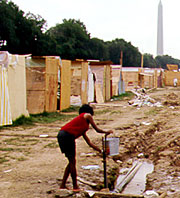
- Resurrection City, June 1968
- (Ollie Atkins Photograph Collection, Special Collections & Archives, George Mason University Libraries)
- Enlarge This Image
Forty years ago, on this weekend in 1968, men and women were arriving from all over the country to Washington, D.C., as part of the Poor People's Campaign. It was the last movement organized by the Rev. Martin Luther King, Jr., just before his assassination.
Web Resources
- Jill Freedman
- Ollie Atkins Photograph Collection, Special Collections & Archives, George Mason University Libraries
- Higher Pictures Gallery
More From Ann Heppermann
More From Kara Oehler
This Weekend in 1968
Rev. King had the vision to bring together poor people of all races to make visible the plight of poverty. It was not to be a sit-it, but a live-in. They built "Resurrection City" on the mall on Washington -- and the legacy of this city's rise and fall lives today.
This weekend in 1968 was the opening of Resurrection City. We start the story with Dr. Bernard Lafayette:
Dr. Bernard Lafayette: I got a call from Martin Luther King. This was in '67. He said, 'I need you to come down to Atlanta and to move here and work full time. This may be my last campaign and we're going for broke.' And when I got to Atlanta, he appointed me the national coordinator for the Poor People's Campaign. Now the idea originally came from Marion Wright Edelman.
Marion Wright Edelman: I was Marion Wright back in 1968. I had been working with Robert Kennedy on poverty in Mississippi, and he told me to tell Dr. King to bring the poor to Washington. To make them visible.
Lafayette: And the idea was that we would bring those people in front of the folk who make decisions and build this tent city and camp out until you get what you want. The two of us, we're talking, so I said to MLK, 'Well, you say this is a PPC. Well, black people aren't the only ones poor -- are you talking about getting Hispanics involved?' He said 'Yes!' 'What about Native Americans?' 'Yes!' So I was getting to the final question, and that was the poor whites from Appalachia... He said, 'Are they poor?' He said if they were poor then this was their campaign.
Edelman: And so the planning began. I was with MLK on April 4, 1968.
Lafayette: I was there at the Lorriane Hotel in his room, 306. That morning, we were talking about the details now of the Poor People's Campaign and the press conference we were going to have in Washington, D.C. So I got on a plane, and five hours later, he was assassinated.
Walter Fauntroy: My name is Walter Fauntroy.
Lafayette: Rev. Walter Fauntroy was the man who was operating between the government and the poor people.
Fauntroy: And it took all we had to say. They killed the dreamer... 'Come to Washington.' So they came with some hope.
Edelman: They came by bus, by train.
Rev. Ruby Reese Moone: I am the Rev. Dr. Moone Reese Moone.
Edelman: They came in a mule train from the South, and the mule trains were very slow and very hard.
Moone: Thousands and thousands of people... From all across America.
Edelman: I discovered a map of Resurrection City recently that I didn't know existed which is an aerial view. It looks like a refugee camp.
Stoney Cooks: A city of plywood, teepee-looking A-frames, houses. There were some people who really made their A-frame look like home. A little family would dig up flowers and put them around their A-frame.
Edelman: Between 2,000 and 5,000 people were crammed in there for May and June.
Cooks: I mean literally, every available spot was taken.
Lafayette: We had full facilities for a city. So we had to have a mayor.
Voice over loudspeaker: 'I would like to introduce to you Dr. Ralph David Abernathy -- the mayor of Resurrection City! Yeah!'
Fauntroy: There was adequate food, a City Hall.
Lafayette: Sewage.
Fauntroy: Health Care.
Lafayette: Schools.
Cooks: Every single day, we started with a demonstration at the Department of Agriculture. And then we'd branch out from there.
Fauntroy: People were organized in their areas of interest. If you were an Indian, you wanted to go to the Interior, to talk to people in Indian Affairs. Let them know that policy needs to change. If you were a farmer, you went to Agriculture. So it went -- well, early on. Some despair drifted in when the people they talked to... seemed nasty. 'I don't want to be bothered with you poor people. You are a problem. You are tax eaters.' That kind of foolishness. But we always picked them up when we got back. They have a good hot meal and some entertainment.
Lafayette: Musicians came in the evening.
Fauntroy: Oh my goodness!
Cooks: Jimmy Collier.
Fauntroy: Peter Paul and Mary.
Lafayette: I think Pete Seeger came...
Fauntroy: And we got to singing...
Lafayette: So, always visitors coming through. Even when there was mud and everything else.
Cooks: Every day. It would be nice and bright and all of a sudden clouds would come through -- and ha! The rain.
Moone: People got tired of living in the wet.
Cooks: There were even rumors that the government seeded the clouds.
Lafayette: Somebody counted and they said it rained for 40 days.
Fauntroy: Which sort of amplified the despair. And when you've got a muddy spirit and muddy eyes and a muddy future, you turn on one another instead of to one another.
Cooks: We had robbery, burglary.
Lafayette: Cooks probably didn't tell you this, but some guy came in to rob and Cooks gave the person the impression that he was going to give him the money, but instead, Cooks knocked the gun out of his hand and the barrel of the gun fell out.
Cooks: It was 4,000 or 5,000 people, and all of their problems.
Voice on radio: 'Sen. Robert Francis Kennedy died at 1:44 a.m. today...'
Fauntroy: June the 5th, 1968.
Cooks: To hear the Robert Kennedy was assassinated, it was like 'My God, again.'
Fauntroy: It was hard, people just went crazy. They were cussing out nuns who were coming every day to feed because they were white. They were turning on one another -- 'You Hispanics are taking our jobs, you Indians should have beat the Cowboys.' There was just a pervasive angryness.
Moone: The leadership of the Poor People's Campaign were very disgusted. They were not getting Congress to listen. And they were saying, 'You're going to hear us before you leave.'
Fauntroy: And the Federal Government said, 'Look, if you could control the people, put them in the kind of discipline we had when it was beautiful, fine.' And as I said, all of a sudden. It just popped out!
Cooks: The bulldozers came in from the 17th St. entrance.
Edelman: I think it was June 24th.
Cooks: People were told move out or you're going to be crushed over.
Fauntroy: And I went down there and watched it. Helplessly.
Cooks: This was demolition. They bulldozed it.
Fauntroy: The people I had been talking to didn't have any prior knowledge of it.
Cooks: And in a very short period of time, there was no more Resurrection City.
Fauntroy: I think Resurrection City is remembered as a failure, but even its failure lifted us to higher ground. At least, that's how I view it.
Lafayette: Whether it ended poverty, the answer is 'No.'
Edelman: Change is a long, hard thing.
Fauntroy: Martin Luther King put it this way: 'The arc of the moral universe is long, but it always bends towards justice.'
Edelman: And I think it's really important for people to know that, while they went back home in despair and depressed, a lot of follow-up occurred which did lead to major federal investment in nationwide nutrition programs, like food stamps and school lunches. So the Poor People's Campaign struggle was not in vain.
Fauntroy: So, I look back on the Poor People's Campaign and that decade, as painful as it was, as what was necessary to awaken enough people to change public policy. (singing) 'We shall overcome, deep in heart, I do believe we shall overcome' ...And that's that.
More stories from our This Weekend in 1968 series



Comments
Comment | Refresh
12/31/2014
I was 13 when my mother took my little sister (9 years old) and I to Resurrection City. We lived in Virginia at the time. My mother had been drinking. We waded across the Reflection Pool and went into the tent where Ralph Abernathy was speaking. As I looked around, I didn't see any other white people besides us. It was a it scary, but also exciting to see people try to change things. It is an experience that changed me forever. I am and have been an activist ever since.
From Stamford, CT, 05/08/2014
My sixth grade teacher always sponsored a class trip every year to DC. That year after weighing everything and speaking with the parent they decided it was more important than ever to make the trip. Being raised upper middle class in the suburbs I was shocked. We actually thought everyone was there because they had no homes, but Mr.Murdock explained the objectives and reasoning behind what he called a "civil action" and that we were witnessing history; that these people were here to represent the millions of poor in our country. I dont think that at the time we understood fully, but I know we (myself in particular) were extremely affected by what we saw. It shaped my political perspectives for the rest of my life. It is so much more inspiring 40 years later now that I can fully appreciate the beauty, power and struggle resurrection city represented. I also now appreciate what it took for our parents and teachers to decide not to cancel the trip and I am forever grateful to have witnessed it.
From Woodbridge, VA, 05/04/2014
I too remember Resurrection City, and saw a semblance of it this weekend. Last night I saw a scene that will be long remembered in my heart. A church youth group gathered at a local Methodist church on Friday evening with boxes, posters and markers. They designed their own Resurrection City. They slept in card boxes and sleeping bags. They fasted from Friday noon until Sunday at 6:00 pm -thirty hours. During this time they made posters, wrote down their thoughts, and created unique projects in pursuit of a better understanding of hunger and poverty. The concept that thousands, especially children, are starving to death every day is not so easy to comprehend. As I walked around all the "cardboard homes" I thought, " Wow! the beginning of another 'Resurrection City' and from a new and younger generation with high, but achievable goals to end hunger."
From Philadelphia, PA, 02/18/2014
Was a tenant at Resurrection city for 15 days. I was 15 years old. My friend, Wiley Cahoe and i left on a bus from 22nd and Then Columbia avenue. It took us three days to get there. We were threatened by the Klan when we made a stop in Greenbelt, Md. It was a glorious experience for a then 15 year old. We saw Jesse Jackson, Ralph Abernathy, and all the top people from the SCLC and NAACP. It forever changed my life.
From Chicago, IL, 10/13/2013
I was 21 yrs old when a young Jesse Jackson came thru Miss. Preaching that he needed people to march with him to washington DC. Iwas newly married with a young daughter, but i knew that i had to be a part of this amazing event, so i listen to Jesse speech and when i talk face to face with him, I also convince my mother to bring my 8 yr. old brother along, also i was able to convince another lady to cone along and by the way she bought along her 4 or 5 young children along, we lived in tent city for 3 or 4 months until they over rode it with roit police on horse back and bulldozer, me and my family had to run for our lives, thank god for that white lady whi pick me and my wife and my 1yr. old daughter up and took us to her house in Virginia, treated us like royalty, I believe it was the next day i am not for totally sure, after i found my mother and my young bro. this angel took us all to the bus station and ask us where did we wantt to go, she bought tickets and sent us on our way, if only there was some way to thank her.
From Jackson, SC, 08/21/2013
Summer of 68....Innocent as it was my Aunt & Uncle had just talked me into going back to Tidewater, VA from Buffalo where I was on summer Vacation... I was 12. We stopped in Falls Church to spend the night, my other Aunt lived there. The next day we went into D.C. to see the sites, not knowing what was going on! I can tell you now that when my Uncle Jack dropped me off in front of the Wash Monument for me to go up, Who knew! WOW did I get a view from the top... EVERYWHERE you looked tents and shacks as far as I could see! Here's the point! Little did I know I was in the middle of History. To this day I can clearly see this....So why is it back then Blacks did this kind of thing peacefully! And today I have to carry a concealed weapon everywhere I go ? Changed world folks. Changed......And How did we get here! Not for me to say for you, but for me, it stared about 6 yrs ago!
From New Orleans, LA, 08/12/2013
The Savannah, Ga chapter of SCLC afforded Me the honor of attending the PPM. If my memory serves me correctly, Hosea Williams headed our sojourn. I was awed by the thousands of people who braved the harsh weather with determination. I remember the mud, the smell and being very tired, but i also remember the pride I felt. We were determined to make a difference. Are there any readers who remember the SAVANNAH FOLK WHO WERE THERE? I would love to talk to them. I am still very proud to have attended. I am 68. I hope this march willalso be remembered.
From New Orleans, LA, 08/12/2013
The Savannah, Ga chapter of SCLC afforded Joe the honor of attending the PPM. If my memory serves me correctly, Hosea Williams headed our sojourn. I was awed by the thousands of people who braved the harsh weather with determination. I remember the mud, the smell and being very tired, but i also remember the pride I felt. We were determined to make a difference. Are there any readers who remember the SAVANNAH FOLK WHO WERE THERE? I would love to talk to them. I am still very proud to have attended.
From Rome, NY, 03/12/2013
I joined the SCLC in June of 1968 and took up residence in Ressurection City to establish an unofficial McCarthy campaign headquarters. By this time mud and fatigue had taken its toll. I don't recall eating anything except peanut butter on bread baked in coffee cans. There was scrambled eggs in the morning, but I had an aversion to them. The Mayor was actually Chief Crooked Snake. At the last "town meeting" a few days before the end, the subject of marching on Agriculture came up as did the problem of the Indian contingent staying in hotels rather than on the grounds. The mood was not to back the Indian's ddemonstration scheduled for later that day (as I recall). I spoke up that the cause was bigger than the issue. I was immediately verbally challenged by some black residents, who said I shouldn't have a voice, since I was white. I told them they had no monopoly on poverty. The argument was not quelled by Crooked SSnake. Suddenly, Ralph Abernathy appeared. His solution was to dissolve the town government. I can only imagine the hell he was going through. A day or two later we marched on Agriculture. Approaching the building a stout black woman, well dressed in a white skirt and jacket crossed the street out of the pedestrian walk. A police officer cracked her in the head with his baton. She was bleeding heavily. The blood had made red lines on her patent leather bag. The sun was bright. Jesse Jackson lifted her bag into the air like a flag. The sun glistened off the bag, while he made a powerful speech. It was a photo op of a lifetime, but I had no camera. I'm greatful for this opportunity to record that moment, which is with me forever. In the final twenty-four hours paranoia ran deep. The threat of a violent confrontation with police seemed possible. Some renegades were advocating armed resistence. One even offer me a gun on the final morning, while we stood near Lincoln's Memorial watching the police rushing down into the town from the left, knocking down our empty plywood shacks with their night sticks. It was absurd. By the way, I've always thought the man who offered me the gun was an outside agent. Williams, the strong arm of the town, warned against an armed conflict with "pea shooters". After the town fell I walked to SCLC HQ in D.C. It looked like a court room or meeting hall. From the back came Jesse Jackson who expressed alarm that I, a white, was in the heart of black D.C., when a riot seem possible. He directed an assistant to get me out of there and over to the bus station, where Traveler's Aid was passing out free one-way tickets home. When T.A. asked me where I lived, I picked the farthest point away I could think of, Portland, Oregon. They issued a ticket and gave me $35-. The rest is another story. Looking back at '68, I think it was a pivotal year in our history. I was glad to be a small part of it.
From san francisco, CA, 03/03/2013
I organized a fund raiser at Galileo High School and sent a check to Resurrection City. I was almost kicked out of school because we were only suppose to fund raise for the Red Cross, I contacted the Press and was able to send a check for around 125.00 of monies collected from students at Galileo High School in san Francisco.P atricia Pittman- Mitchell
From san francisco, CA, 03/03/2013
I organized a fund raiser at Galileo High School and sent a check to Resurrection City. I was almost kicked out of school because we were only suppose to fund raise for the Red Cross, I contacted the Press and was able to send a check for around 125.00 of monies collected from students at Galileo High School in san Francisco.P atricia Pittman- Mitchell
From san francisco, CA, 03/03/2013
I organized a fund raiser at Galileo High School and sent a check to Resurrection City. I was almost kicked out of school because we were only suppose to fund raise for the Red Cross, I contacted the Press and was able to send a check for around 125.00 of monies collected from students at Galileo High School in san Francisco.P atricia Pittman- Mitchell
From CLIFTON, NJ, 11/23/2012
I was about 11 years old; my family lived in one of the suburbs outside Washington DC. My father took my sister and me to Tent City one Sunday after church. Friends and family told him he was crazy, irresponsible to take two young girls "down there". Nope, my father said, I want my children to see and understand what is really going on in this country. He was deeply disturbed by the assassinations of MLK and RFK and for him, JFK was a hero - he didn't want his children to live in a world of deluded seclusion. My experience of walking around the fringes of Tent City on the Mall that sunny afternoon was one of the most formative experiences of my early life. My first visual impression of Tent City from a distance is embedded forever in my mind.
From Rockville, MD, 08/12/2012
I was only 14, but I watched it all on the news with wide eyes as the known world shifted. I really talked to black kids for the first time, even visited their homes without my mother knowing. The Poor People's Campaign changed my life, burst it wide open. Soon after I got the speech on 'why we don't date negroes'. Amazing times, huge changes.
From Rocky Ridge, MD, 09/28/2011
I was a senior in HS in '68 and went to Resurrection City to help build the plywood huts. When those were finished, I went there and as a young white girl, I didn't go thru the front gates, but walked down the fenceline until I found a break, and got in that way. I went to the Day Care place and spent my time watching the kids when the parents were protesting, feeding them and finding clean clothes and diapers. I slopped thru the mud and filth. I saw Mrs King with the others walking thru one day. There were the Rangers, who patroled the place. The ones I knew were not gang members. They all wore berets. After it was destroyed, I helped take food to those left. The Methodist churches did a great deal to help. My parents didn't know about much about my time there, but the images from the Poor Peoples Campaign have remainded with me for all time. Sadly,too few people remember this time.
From MD, 06/21/2011
Early in my young life, my parents tried to protect and shelter me, not wanting me to see the negative side of life. Always praying things would be better when in reality, the world was getting worst. So in 1968 when I was 15, I was up with the news and knew how the world was. My family took me to Resurrection City. And I saw a group of people with fight in their hearts and hopes that some how or some way their message would change the world. Being much older now, I realize their hopes were not in vain, Matthew chapter 6, verses 33, 34 state if we seek first the kingdom (God's government) and his righteousness, all these other things will be added to you, so never be anxious. All of those people and we too, are seeking and with prayer, it will come, nationwide.Everyone, forever.
03/23/2011
My memory is a bit cloudy but I was on-site in Washington D.C. in 1968 as a messenger for a law firm. I was at the great mall looking at some rubble on the ground, rubble from Resurrection City. I felt a part of history just then....didn't know that it was the RFK assasination that led to its' demise. To my way of thinking Obama is a child of Resurrection City....amen!
From OH, 02/28/2011
Indeed I was there! Walked through the rain and mud, holding hands with Eartha Kitt! We were not wanted there, and thank God we got out before the gasing took place. It was a time to remember, and I'm sure another 'City' will happen in order to bring attention racist attitudes that prevail in these states of America! God have mercy!
From Louisville, KY, 01/29/2011
Does anyone remember the location where we prepared the wood for the A-frames for Resurrecton City? Some where out in Maryland? Also the name of the church in the northwest where we had come training? Later at a motel closer to downtown? What is the most decriptive book? Mo
From Washington, DC, 08/28/2010
First,of all, let me say that I am so greatful that my mother, Sylvester and her girlfriend, Sgt. Rita Myers were both in the March on Washington in 1963. When Resurrection City came to WDC, I was 16 years old, and wasn't even suppose to be in WDC(I lived in Arl., VA at the time). I snuck over to see just what was going on at the Mall. What I saw from 14th street down toward the Capitol, was breath-taking. I walked down through the entire City, in the mud(it had just rained), looking at the conditions, smelling the awful smells of the outside usage of toilets(not porta-toilets), but raw sewage. I spoke with a lot of people there, both young and old. The stories some people told me about their lives, was devastating. Resurrection City was a place where the people came from the deep south to have themselves noticed and reckoned with; wanting to be acknowledged, helped, loved. Something better for themselves and others like them. I wish that every body could have experienced this walk as I did. The walks, talks, sights were phenomenal. If ever there be another, of this such, everybody should take the opportunity to participate. VERY educational. I am greatful for this day.
From Akron, OH, 04/27/2010
I lived in the city with hope that things would change.As a young person going to jail everyday was indeed very rough on the spirit. I tell my children today to keep hope alive we still have much work to do.
From Akron, OH, 04/27/2010
I lived in the city with hope that things would change.As a young person going to jail everyday was indeed very rough on the spirit. I tell my children today to keep hope alive we still have much work to do.
From Harlingen, TX, 04/11/2010
I was a teenager on a trip to D.C. with my Girl Scout Council in Southeast Missouri. We traveled by bus. Enroute we got the news of Bobby Kennedy's death. As we toured D.C. we went up into the Washington Monument and I took pictures of the encampment. Moving over to the Lincoln end of the mall, we had to skirt Resurrection City. We had to go behind the speaker stand to get to the steps. I remember seeing the young Jesse Jackson and Rap Brown. I knew those faces because I watched Walter Cronkite on the news every night with my parents. I knew I was seeing history being made. I do remember all that mud. I will never forget standing on the steps of the Lincoln Memorial, looking out over Res. City and seeing all the flags around the Washington Memorial at half staff in honor of RFK. It was a powerful moment for a young girl from Missouri.
From clinton, MD, 03/20/2010
I volunteered my services for Southern Christian Leadership Conference (SCLC) for the Resurrection City Project in May,1968. I was the Head Electrician in the evening bringing numerous volunteers while recruting other volunteers on the site. Working over 8 hours a day 7 days a week. This particular night I was finishing up my last job when someone called out to me questioning me as to what I was doing up on the roof, in the dark in the rain that time of night (11:30pm), as I explained to the gentleman while still working, that I had promised the lady that day she would have some electricity in her Hut before I went home, and as I came off the roof I noticed the gentleman was was Rev. Jesse Jackson. I was the one who was installing the electric lights and rec.plugs inside of the wooden Huts. so the families could have lights inside. This went on throughout the entire project. Being a young Journeyman Electrician I had the pleasure of meeting so many Black Master Electricians who contracted during the day. I was so elated it was like going to the SuperBowl. A lot of people had problems getting volunteers to help, but I never had a problem in that area. Some people who came to work on the Project, never left the Pitts Motor Inn Hotel to get mud on their shoes. I've had the pleasure of meeting Mrs. Coretta Scott King;Rev. Jesse Jackson; Rev. Frauntroy, Rev. Dr. Lowery and a host of others. Also,I had the pleasure of knowing Rev. Hosea Williams, Dr.Ralph Albernathy and Thrayer Management Services. After the Resurrection City Project,I had some job offers from some of the Master Electricians and SCLC which offered me a job teaching the Electrical Trade but I had to decline because of my family and I had ten years on my present job. Every time I visited Atlanta, Ga I would stop by the SCLC office on Auburn Avenue to see my friend Rev. Hosea Williams. The offer to help volunteer for the Resurrection City Project as Head Electrician was a Blessing which changed my life, knowing that I have contributed to the cause in helping my childrens, children get a better education for a better position or a better opportunity in life.
From Washington, DC, 03/16/2010
How nice to come across this entry about Resurrection City. I am so sorry I didn't publish anything regarding the role I played. I was the official working Dietitian on-site for the entire time at Resurrection City(RC). I was officialy detailed to RC by Dr. Murry Grant, the Director of the DCDPH
to serve as On-Site Dietitian. I was responsible for assuring (along with support of Mr. Carter of the Inspection Division of the Health Department)that we had a safe food supply. I have a story to tell about that experience. Would like to be a part of the history recording that important event in our history.
From Boulder, CO, 02/19/2010
I was a school librarian in D.C. when Dr. King was assassinated. It was a black school and all of the sixth grade class walked out on me. In the afternoon schools were closed and I had no car. The counselor drove me to my apartment on Capitol Hill. My seven year old daughter met me on the corner. Her teacher had abandoned the class. A neighbor was taking her home. We watched the burning on H Street that night. Resurrection City I remember from the photos. I think it rained most of the time. Can someone tell me if that was so?
From houston, TX, 07/23/2009
great story
From Philadelphia, PA, 05/22/2009
I am happy to see that this storey is alive, I was involved from the start,for me it mostly began at 14Th and U st NW where SCLC office was ,where white folks would come and ask ,do you think the blacks will come into my neighborhood, at the same time were getting out their check book buy peace,people had been rioting after DR. kings murder a few weeks back.LINDA a young INDIAN woman was the person to break the ground for Resurrection city,INDIAN chief CLIFF HILL gave land rights,after that it was on ,charter BUSES were burned on the spot the Blackstone Rangers from Detroit and Meany others gangs arrived, it was something else,people did thing that you would not wont to believe both good and bad SAMMY DAVIS JR came in his ROSE ROSS,HARRY BELIFONTE,was there working with Trash clean-up. doing the day is one style of life and night oh my GOD it was another,the big shots and the PIT HOTEL, JESSIE JACKSON,MISS STAR,ANDREW YOUNG and personal aid SCOTT and friends ,if only the truth would come out that young KING daughter RUNNING around doing all sorts of things guys were at the chase she was about 16 or 17 at the time,Montgomery Alabama police jacket found hidden in one of the meeting room after a meeting at SCLC office 14Th-U st.RACism at that time and now.
From Cambridge, MA, 01/28/2009
As a former resident of Resurrection City, there from the construction of our plywood lean-tos until the bulldozers drove us out, it was absolutely so amazing to see Barack Obama inaugurated. I wish I could have been on the Mall again for the occasion, but it was still inspiring to watch it on television.
From Eden Prarie, MN, 01/24/2009
I have just returned from witnessing the inauguration of President Barak Obama. While standing on the Mall with one million other Americans something was tugging at me. When I got home i recalled Resurrection City from my youth. My father was a congressman from MN in the 60's. During the summer of 1968 walked down from the capital and offered Andrew Young to use his office 'on the Hill' for organizing. Later that week my mother took the five of us children to see the plywood city on the Mall. We walked through the muddy avenues and peered inside the A-frames. it was a sad situation.
Four days ago i took my wife and two of my children to DC to witness history. We stood almost on the same spot where 40 years ago another group of people gathered in Resurrection CIty. A resurrection happened on Tuesday!
Rev,. Joel Quie
From Oak Park, IL, 11/24/2008
As Brother Jean, CFX, (Xaverian Brothers -- Roman Catholic order of teaching brothers), I was responsible for coordinating the sourcing of lumber, volunteers, construction, and delivery to Resurrection City (located on southside of the Washington Mall Reflecting Pool). These "A-Frames" provided shelter and communal buildings for Poor People's Campaign participants. Soliciting donations and raising money to pay for building materials was a constant challenge. Security at the building site (athletic field of Xaverian College in Silver Spring) was a constant concern. At one point, it seemed we had more volunteers from the ranks of FBI and military intelligence agents. Memories: (1) standing guard at night to protect construction area from sabotage; (2)renting 18-wheeler with 40 ft trailer from Hertz and personally driving loads of A-frame components to the site for further assembly; (3) meeting with Rev. Abernathy and his leadership team pleading for payment of outstanding bills; and 4)visiting Resurrection City during downpour, seeing flooding and squalor (lack of sewage disposal/fresh water) and seeking out SCLC leadership that night at Pitt's Motel lounge for help -- which never came.
From district of columbia, DC, 06/19/2008
i am just learning about this story of what happened, and my heart goes out to the people who suffered though this, jsut from listening to this, i can see that the enemy came in like a floor and destroyed that which GOD was builing, he took all of the major leaders, which represented the head,and without the head the body cannot live, but the BIBLE say vengence is the LORD and he will REPAY. Even though people has went on with their lives and forgotten about this, but GOD never forgets, and he never sleeps, i pray that GOD bless everyone who suffered though this, and even the ones who came against this project, AMEN
From Jackson, MS, 06/04/2008
I attended the funeral of Dr. King in Atlanta and returned to Jackson to graduate from Lanier High School on June 5, 1968. A few days later, I joined some others from Mississippi and headed to Resurrection City. Reverend Jesse Jackson led a group of us to the U.S. Department of Agriculture to protest. After residing in a makeshift wooden hut, we were arrested and my friend, Emmanuel Daniels was taken to Fort Belvoir, Virginia. Not being 18, I was incarcerated in the youth detention of the D.C. Jail. Following my release, I was given a one-way ticket back to Jackson. A few days later, Emmanuel got back to Jackson. Gene C. Young, Ph.D., Jackson, Mississippi
From Los Angeles, CA, 05/16/2008
I, along with a friend (Ed Anderson), organized a class of 33 students from UCBerkeley who came to DC to be participant observers in the PPC. We had an academic sponsor at UC and worked with Arthur Waskow of the Inst. for Policy Studies in DC. Rev. Lafayette and Stoney Cooks were our 2 primary contacts with SCLC.
I, personally, was one of the very few of us who actually lived in the exhilarting mudhole known as Res. City--we were all initially placed with volunteer local families.
I'm sick that I missed this broadcast last week (I get the newsletter but left work early last Fri). I became a lawyer and am now an LAUnified HS teacher. It was probably the single most significant event in my entire life--childbirth included!
Thank you for this--most people really don't remember it (you tangentially mentioned RFK's assassination--there was an "uprising" in the camp--it was middle of the night for us--and the police came in and tear gassed us. It was absolutely the scariest night of my life!
thank you.
Janis Cohen-Milch
From Playa del Rey, CA, 05/10/2008
Thanks for the segment on "The Legacy of Resurrection City." It is important that listeners (many of whom are citizens of the USA and all of whom are citizens of the world) know our history and how we have gotten to where we are today. Great job! Very interesting programs--from Jello wrestling and beyond! Keep up the good work.
From Chicago, IL, 05/10/2008
I just heard the story about Resurrection City, and I remember hearing about it at the time on the radio news regularly. I had large hopes and expectations, being young and naive, that more would come out of it and wished I could get out of high school to be there. Today, when I listened to the part about the bulldozers coming in, I thought at least the people in attendance could be grateful that they weren't treated the way the war bond protesters were when they camped out after WWI--they were overrun with cavalry, shot and stabbed, women and children alike, according to a PBS program (if I remember correctly) I saw about it, and I believe Gens. MacArthur & Patton were involved; yes, the same two who later went on to great fame & glory in WWII. Short collective memories most Americans have! Thanks for the memories of the dreams many of us shared in the 60's.
Post a Comment: Please be civil, brief and relevant.
Email addresses are never displayed, but they are required to confirm your comments. All comments are moderated. Weekend America reserves the right to edit any comments on this site and to read them on the air if they are extra-interesting. Please read the Comment Guidelines before posting.
You must be 13 or over to submit information to American Public Media. The information entered into this form will not be used to send unsolicited email and will not be sold to a third party. For more information see Terms and Conditions and Privacy Policy.